Case study · 2026
A private project board for an interior design studio
Two houses under renovation at once, four people involved, and a shared spreadsheet that had stopped telling anyone the truth.
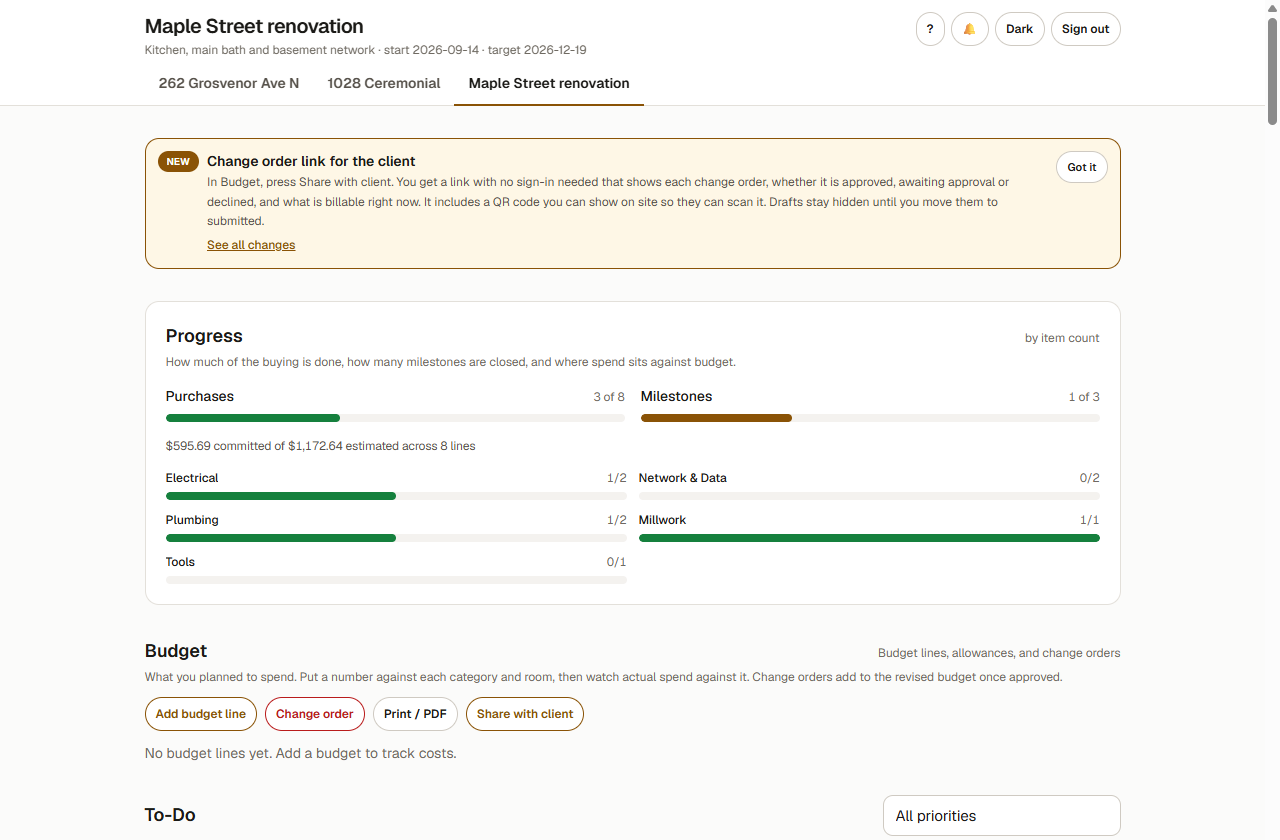
The live board, shown with demonstration data.
The problem
A renovation runs on a hundred small decisions: what to buy, where it goes, who is buying it, and whether it has actually arrived. Spreadsheets break at the point where more than one person needs to change the same row. Nobody can tell which items are already bought, nobody wants to ask, and the person doing the asking is the one paying for the mistakes.
The requirement was narrow and specific. Two households, a handful of trusted tradespeople, private by default, no per-seat subscription, and it had to work on a phone on a job site with one hand.
What I built
An Astro front end on Cloudflare Pages with Pages Functions for the API, D1 for the data and R2 for files. Everything sits behind a login. Nothing about the site is public, and it does not appear in a search result.
Per-person accounts, not a shared password
Each person gets their own account with a salted PBKDF2-SHA256 hash, a signed HttpOnly session cookie, five failed attempts before a fifteen minute lockout, and a password reset that revokes every existing session. The runtime caps PBKDF2 at 100,000 iterations, which is the platform ceiling rather than a preference, so the lockout and the session rotation carry the weight that extra hashing rounds cannot.
Bills of materials by trade
Every line carries a department (plumbing, electrical, network, millwork), a kind (material or tool), a quantity, a unit cost, a room and a note. Items group by trade, filter by kind, and an item does not need a product link. Paste a product URL and the title, image, supplier and price fill in by themselves. Retailers that block datacenter IPs fall back to an external fetcher, which is what makes the big box stores work.
Bought state you can read at a glance
Open items are red, bought items turn green with the title struck through, and the state is carried by border, background, strike and checkbox rather than colour alone, so it survives a colourblind user and a black and white printout.
Documents that stay private
Quotes, permits, invoices and drawings upload straight from a phone, tagged by department and room, up to 50 MB. Files are stored in R2 and served only through an authenticated function: an unauthenticated request for a file returns 401, which I test on every deploy.
An audit trail on every change
Each edit writes an event with the actor, the field, the old value and the new value, so a year later you can answer who marked a line bought and when. Writes that change nothing write nothing, so the log stays readable.
Read-only lists you can send
Filter to a trade, press share, and you get a link that renders a printable shopping list with no sign-in required. It groups by department, totals the estimate, and offers a single button that puts every Amazon item on the list into a cart at once.
Constraints that shaped the build
- The password hashing ceiling is set by the platform, so security effort moved into lockouts, session rotation and generic error text.
- Object storage required an account-level activation before a bucket could exist, which is why the storage layer is an adapter rather than a hard dependency.
- Retailers refuse requests from datacenter IPs, so product previews run a fallback fetch instead of assuming the direct one works.
- Mobile first was literal: 44 pixel tap targets, 16 pixel inputs so iOS does not zoom, and no horizontal scrolling at 390 pixels wide, all asserted in a browser rather than eyeballed.
How it is verified
Every deploy is followed by live checks: sign-in, wrong password rejection, project switching, department and kind filters, file upload and download byte comparison, an unauthenticated download returning 401, share links rendering without a session, and audit events appearing for each kind of change. Contrast ratios and tap target sizes are measured from computed styles in a real browser at both phone and desktop widths.
What I would add next
A scheduled export of the database to object storage, expiry on share links, and a change log view that filters by person rather than by record. None of them are hard, and all three are the difference between a tool a business uses and a tool a business trusts.
Stack
Astro, Cloudflare Pages and Pages Functions, D1 (SQLite), R2, KV, Tailwind, and no third party service holding the data.
Need something like this?
I build private operational tools for small business: trackers, quoting systems, client portals and reporting that is not stuck in a spreadsheet.
Work with me